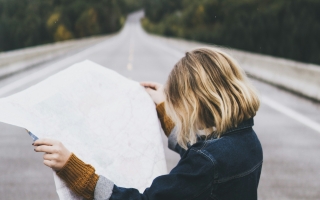
What getting lost taught me about finding direction

My husband dropped me off in the middle of the New Forest and headed on to his meeting in Southampton. I was excited about the prospect of getting out into nature, something that can enhance well-being and that I try to do as often as the fair-weather walker in me permits.

I had my water and snacks, and my camera, of course. I was feeling positive about the direction I was going in. Ahead of me was an estimated 90-minute walk to a lovely village where we would meet later.
Easy?
No. My reliance on technology and the satnav on my phone soon changed things for me, and I got lost. I don’t know how, but I believe Google thought there was a path when, in fact, there wasn’t.
According to my phone, I was standing on the blue line that indicated a path, but when I looked around, I was surrounded only by grassy marshland and trees. My once-clear path was now a sticky swamp.
I stood for a while, considering my predicament until I decided to take action. Any action was surely better than this, so I walked for a few miles in the wrong direction.
On this route, I saw birds of prey, rabbits and a single magpie. I’m not usually superstitious, but this instinctively warranted a map check, which clearly indicated I was making a mistake.
I turned back, finding myself on the same blue line, let’s call it the non-path to nowhere. By this point, I was starting to become unable to see the wood for the trees, quite literally.
Inspecting my map once more, with my focus on my final destination, I ignored the frantic buzzing of my phone telling me to turn around and stand back in the shaded forest. I started to trust my instincts instead.
The “shoulds” of my only travel companion were silenced, and I found myself on a path in the middle of the woods, with not a person in sight and only the sounds of the birds to listen to.
It was at this point I started to think about the concept of feeling lost. I thought about the “shoulds” we put on ourselves when trying to decide the “right” direction and the beauty of trusting your instincts, making mistakes and questioning information that we are told is best.
Did I have doubts, bordering on panic, that I wouldn’t make it out alive and that the bears of the New Forest might find me for breakfast? Yes, a little.
Before I allowed myself to submit to the anxiety and let my fight-or-flight response take me on a fantasy ride, I considered the worst-case scenario. The most realistic outcome was that I would turn back to where I had started and begin again. Perhaps this time I would ask for support and get directions from someone who could help.
Of course, my mind teetered on the edge of even worse worst-case scenarios, but I told myself: “I am safe. I am confident. I am going the right way.” I knew with absolute certainty that I was right.
As human beings, we can quite often think ourselves lost. The useful thing about recognising this is that we may also be able to change how we think about and respond to the situation.
We can feel lost or stuck – often both – but being lost is a concept that may evoke different feelings in each of us. It is the feelings behind the thoughts that are important here.
NLP often focuses on how we experience a problem rather than only on the problem itself. Learned behaviours can change, and new habits can be formed, if that is something you want.
I’m reading a book at the moment called The Idle Traveller: The Art of Slow Travel by Dan Kieran, in which the author talks about his first travel experience, when he and a friend realised that they were ill-equipped in a hot country and very lost. He describes the moment when he moves past the fear attached to this idea:
“We had found genuine escape and for the first time in our short lives had an inkling of what the word actually meant. Freedom from responsibility, and more pressingly, with an empty vista where a career should be on the horizon, liberation from expectation of the lives and the people we would one day become.”
This leads me nicely to the idea that those who are not lost cannot be found. To me, this means that there is some excitement in being lost because it offers the potential for a new beginning.
There can be a fine line, and a similar feeling, between excitement and fear. The difference may lie in how you think about the situation you are in and what you do about it.
Being able to trust that you are where you need to be right now, appreciate what you have in this moment, internally or externally, and recognise how your experiences have led you here can be enlightening.
Deciding it is time to focus on something more or something new, identifying a clear and positive focus and moving in the direction that feels right for you is one way to approach change. It can help to begin from a resourceful state.
That means paying attention to your thoughts and feelings and recognising the difference between them.
It means communicating honestly with yourself about what you specifically want and what is holding you back from getting it. It means considering whether the anxiety you feel and the possible outcomes you foresee are realistic, and whether alternative action could help you avoid them.
It also means envisioning what getting what you want might give you and considering whether that peace, happiness, contentment or whatever the benefit may be for you is worth pursuing.
Three useful elements of change are focusing on what you want, continuing to take positive action towards it and identifying the obstacles that may need to be addressed.
As I sat outside the café in the village where I had arranged to meet my husband, a little later than anticipated but with the sun on my face, the success of being there in that moment was even sweeter because I had experienced a moment in which I had been lost.
Remember: be brave and be beautiful.
Meet some of our coaches
Real coaches, ready to support your next step.



Find the right business or life coach for you
All coaches are verified professionals